Chemical Kinetics and Nuclear ChemistryEasy
Question
For a process A+ B Products, the rate is first order with respect to A and First order with respect to B. When 1.0 mol each of A and B are taken in one litre vessel, the initial rate is 1 × 10⁻² mol L-1 S-1. The rate of reaction when 90% of the reactant have been converted into products would be :-
Options
A.1 × 10-2 mol L-1 S-1
B.1 × 10-4 mol L-1 S-1
C.1 × 10-3 mol L-1 S-1
D.1 × 10-5 mol L-1 S-1
Solution
r = K [A]1 [B]1
∴ r1 = K (1)1 (1)1
and r2 = K (0.1)1 (0.1)1
⇒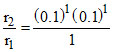
⇒ r2 = 10-2 × 10-2 = 10-4 mol L-1 s-1
∴ r1 = K (1)1 (1)1
and r2 = K (0.1)1 (0.1)1
⇒
⇒ r2 = 10-2 × 10-2 = 10-4 mol L-1 s-1
Create a free account to view solution
View Solution FreeTopic: Chemical Kinetics and Nuclear Chemistry·Practice all Chemical Kinetics and Nuclear Chemistry questions
More Chemical Kinetics and Nuclear Chemistry Questions
In a reaction, A + B → Product, rate is doubled when the concentration of B is doubled, and rateincreases by a fac...A second order reaction requires 70 min to change the concentration of reactants from 0.08 M to 0.01 M. How much time wi...A reaction of first-order completed 90% in 90 minutes, hence, it is completed 50% in approximately :...The differential rate law for the reaction H2 + I2 → 2HI is...In most case, for a rise of 10K temperature the rate constant is doubled to tripled. This is due to the reason that...