Chemical Kinetics and Nuclear ChemistryHard
Question
The bromination of acetone that occurs in acid solution is represented by
CH3COCH3 (aq) + Br2 (aq) → CH3COCH2 Br (aq) + HBr (aq)
Given :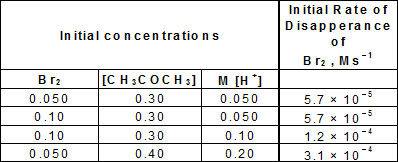
Based on the above data, rate law is :
CH3COCH3 (aq) + Br2 (aq) → CH3COCH2 Br (aq) + HBr (aq)
Given :
Based on the above data, rate law is :
Options
A. = k [CH3COCH3] [Br2] [H+]
= k [CH3COCH3] [Br2] [H+]B.= k [CH3COCH3] [H+]
= k [CH3COCH3] [H+]C.= k [CH3COCH3] [Br2]
= k [CH3COCH3] [Br2] D.= k [CH3COCH3] [Br2] [H+]2
= k [CH3COCH3] [Br2] [H+]2Solution
According to above data.
suppose rate law, = k [CH3COCH3]a [Br2]b [H+]c
by data (i) and (ii) conc. of [Br2] increased 2 times and conc. of [CH3COCH3] and [H+] constant rate remains same. Then zero order wrt Br2.
Similarly conc. of [H+] increased 2 times rate increased 2 times, so first order wrt H+.
Similarly 1st order wrt CH3COCH3
Then, = k [CH3COCH3] [H+]
suppose rate law,
= k [CH3COCH3]a [Br2]b [H+]cby data (i) and (ii) conc. of [Br2] increased 2 times and conc. of [CH3COCH3] and [H+] constant rate remains same. Then zero order wrt Br2.
Similarly conc. of [H+] increased 2 times rate increased 2 times, so first order wrt H+.
Similarly 1st order wrt CH3COCH3
Then,
= k [CH3COCH3] [H+]Create a free account to view solution
View Solution FreeTopic: Chemical Kinetics and Nuclear Chemistry·Practice all Chemical Kinetics and Nuclear Chemistry questions
More Chemical Kinetics and Nuclear Chemistry Questions
Rate of which type of elementary reaction increases with increase in temperature?...If $I$ is the intensity of absorbed light and C is the concentration of AB for the photochemical processAB + hν → AB*, t...If no catalyst (H+) is present in acid hydrolysis of ester (in above question) then rate constant K is :...Which of the following is not a natural decay series :...The half-life of a radioactive isotope is three hours. If the initial mass of the isotope were 256 g, the mass of it rem...