JEE Main | 2014Chemical Kinetics and Nuclear ChemistryMedium
Question
For the non-stoichiometre reaction 2A + B → C + D, the following kinetic data were obtained in three separate experiments, all at 298 K.
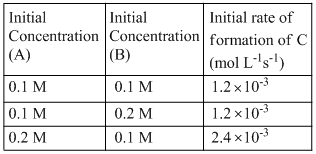
The rate law for the formation of C is
The rate law for the formation of C is
Options
A. = k[A][B]
= k[A][B]B. = k[A]2[B]
= k[A]2[B]C. = k[A][B]2
= k[A][B]2D. = k[A]
= k[A]Solution
2A + B → C + D
Rate of Reaction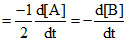

Let rate of Reaction = k[A]x[B]y
Or, = k[A]x[B]y
Now from table,
1.2 × 10-3 = k [0.1]x[0.1]y .......(i)
1.2 × 10-3 = k [0.1]x[0.2]y .......(ii)
2.4 × 10-3 = k [0.2]x[0.1]y .......(iii)
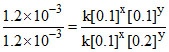
Dividing equation (i) by (ii)
⇒
⇒
⇒
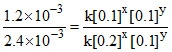
Now Dividing equation (i) by (iii)
⇒
⇒
⇒
Hence = K[A]1[B]0.
Rate of Reaction
Let rate of Reaction = k[A]x[B]y
Or,
= k[A]x[B]yNow from table,
1.2 × 10-3 = k [0.1]x[0.1]y .......(i)
1.2 × 10-3 = k [0.1]x[0.2]y .......(ii)
2.4 × 10-3 = k [0.2]x[0.1]y .......(iii)
Dividing equation (i) by (ii)
⇒
⇒
⇒
Now Dividing equation (i) by (iii)
⇒
⇒
⇒
Hence
= K[A]1[B]0.Create a free account to view solution
View Solution FreeTopic: Chemical Kinetics and Nuclear Chemistry·Practice all Chemical Kinetics and Nuclear Chemistry questions
More Chemical Kinetics and Nuclear Chemistry Questions
A reaction is catalysed by H+ ion;and in the rate law the dependence of rate is of first order with respect to the conce...For a reaction A → 2B, rate of disappearance of ′A′ is related to the rate of appearance of ′B&#...X-Rays are emitted during...Consider following reaction, Zn + 2H+ → Zn2+ + H2Half-life period is independent of concentration of Zn at constan...Which one of the following statement is wrong regarding molecularity of a reaction?...