ElectrochemistryHard
Question
At 298K the standard free energy of formation of H2O(l) is -237.20 kJ/mole while ᐃGo of its ionisation into H+ ion and hydroxyl ions is 80 kJ/mole, then the emf of the following cell at 298 K will be
H2(g,1 bar) | H+ (1M) || OH- (1M) | O2 (g, 1bar)
H2(g,1 bar) | H+ (1M) || OH- (1M) | O2 (g, 1bar)
Options
A.0.40 V
B.0.81 V
C.1.23 V
D.-0.40 V
Solution
Cell reaction Cathode : H2O(l) +  O2(g) + 2e- → 2OH-(aq.)
Anode : H2(g) → 2H+ (aq.) + 2e-
____________________________________
H2O(l) + O2(g) + H2(g) → 2H+(aq.) + 2OH-(aq.)
Also we have
H2(g) + O2(g) → H2O(l) ᐃGof = - 237.2 kJ/mole
H2O(l) → H+(aq.) + OH- (aq.) ᐃGo = 80 kJ/mole
Hence for cell reaction
ᐃGo = -77.20 kJ/mole So, Eo = -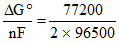 = 0.40 V
O2(g) + 2e- → 2OH-(aq.)Anode : H2(g) → 2H+ (aq.) + 2e-
____________________________________
H2O(l) +
O2(g) + H2(g) → 2H+(aq.) + 2OH-(aq.)Also we have
H2(g) +
O2(g) → H2O(l) ᐃGof = - 237.2 kJ/moleH2O(l) → H+(aq.) + OH- (aq.) ᐃGo = 80 kJ/mole
Hence for cell reaction
ᐃGo = -77.20 kJ/mole So, Eo = -
= 0.40 VCreate a free account to view solution
View Solution FreeMore Electrochemistry Questions
If the pressure of hydrogen gas is increased from 1 atm. to 100 atm, keeping the hydrogen ion concentration constant at ...The electrode potential becomes equal to standard electrode potential when reactants and products concentration ratio is...The specific conductance of a N/10 KCl at 25oC is 0.0112 ohm-1 cm-1. The resistance of cell containing solution at the s...Which Shows electrical conductance ?...Two students use same stock solution of ZnSO4 but different solutions of CuSO4. The EMF of one cell is 0.03 V higher tha...