KTGMedium
Question
Two identical containers A and B with friction pistons contain the ideal gas at the same temperature and the same volume v. The mass of the gas in A is mA and b in mB. The gas in each cylinder is now allowed to expand isothermally to the same final volume 2v. The changes in pressure in a b are found to be ᐃp and 1.5 ᐃp respectively. Then
Options
A.4mA = 9mB
B.2mA = 3mB
C.3mA = 2mB
D.9mA = 4mB
Solution
The initial pressure in the two containers will be
PA = = mA
= mA 
PB = = mB
= mB
After isothermal expasion, pressure will be
P′B = = mB
= mB 
P′A = = mA
= mA 
∴ - ᐃPA = PA - P′A = mA
∴ - ᐃPB = PB - P′B = mB
But ᐃPA = ᐃP and - ᐃPB = 1.5 ᐃ
So, ⇒ - ᐃPA =
mA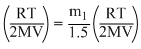
or mA =
∴ 3mA = 2mB
PA =
= mA PB =
= mB After isothermal expasion, pressure will be
P′B =
= mB P′A =
= mA ∴ - ᐃPA = PA - P′A = mA
∴ - ᐃPB = PB - P′B = mB
But ᐃPA = ᐃP and - ᐃPB = 1.5 ᐃ
So,
⇒ - ᐃPA = mA
or mA =
∴ 3mA = 2mB
Create a free account to view solution
View Solution FreeMore KTG Questions
If T is the temperature at which the root mean square velocity of molecules of a gas becomes double of its value at 100o...The molar heat capacity C for an ideal gas going through a process is given by C = , where ′a′ is a constant...If the total number of H2 molecules is double that of the O2 molecules then the ratio of total kinetic energies of H2 to...The pressure of one mole of on mole of an ideal gas varies according to the law P = P0 - aV2, where P0 and a are positiv...One gas of $n_{1}$ mole of molecules at temperature $T_{1}$, volume $V_{1}$, and pressure $P_{1}$, and another gas of $n...