Chemical EquilibriumEasy
Question
Given the reaction between 2 gases represented by A2 and B2 to give the compound AB(g).
A2(g) + B2(g) = 2AB(g)
At equilibrium, the concentration
of A2 = 3.0 × 10⁻³ M
of B2 = 4.2 × 10⁻³ M
of AB = 2.8 × 10⁻³ M
If the reaction takes place in a sealed vessel at 527oC, then the value of Kc will be:
A2(g) + B2(g) = 2AB(g)
At equilibrium, the concentration
of A2 = 3.0 × 10⁻³ M
of B2 = 4.2 × 10⁻³ M
of AB = 2.8 × 10⁻³ M
If the reaction takes place in a sealed vessel at 527oC, then the value of Kc will be:
Options
A.4.5
B.2.0
C.1.9
D.0.62
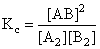
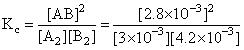 = 0.62
More Chemical Equilibrium Questions
A sample of pure NO2 gas heated to 1000 K decomposes : 2NO2(g) ⇋ 2NO(g) + O2(g). The equilibrium constant KP is 10...If K1 and K2 are respective equilibrium constants for the two reactions XeF6(g) + H2O(g) ⇋ XeOF4(g) + 2HF(g) XeO4(...NH4HS(S) ⇋ NH3(g) + H2S(g)The equilibrium pressure at 25oC is 0.660 atm. What is KP for the reaction....At $T(K)$, the equilibrium constant of$A_{2}(\text{ }g) + B_{2}(\text{ }g) \rightleftharpoons C(g)$ is $2.7 \times 10^{-...The equilibrium constant of the following are : N2 + 3H2 ⇌ 2NH3            K1 N2 + O2 ⇌ 2NO      Â...