Chemical Kinetics and Nuclear ChemistryEasy
Question
The rate law for a reaction between the substances A and B is given by Rate = k[A]n [B]m On doubling the concentration of A and halving the concentration of B, the ratio of the new rate to the earlier rate of the reaction will be as
Options
A.(m + n)
B.(n - m)
C.2(n - m)
D.
Solution
Rate1 = k [A]n [B]m; Rate2 = k[2A]n [1/2B]m
∴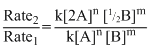 = [2]n [1/2m] = 2n.2-m = 2n-m
∴
= [2]n [1/2m] = 2n.2-m = 2n-mCreate a free account to view solution
View Solution FreeTopic: Chemical Kinetics and Nuclear Chemistry·Practice all Chemical Kinetics and Nuclear Chemistry questions
More Chemical Kinetics and Nuclear Chemistry Questions
Which of the following statement is incorrect about half-life period :...A reaction takes place in three steps having rate constants K1, K2, K3 respectively. The overall rate constant K = . If ...If = k [H+]n and rate becomes 100 times when pH changes from 2 to 1. Hence, order is :...For an endothermic reaction, energy of activation is Ea and enthalpy of reaction is ᐃH (both of these in KJ/mol). ...Given below are two statements :$R = 8.314\text{ }J{\text{ }K}^{- 1}{\text{ }mol}^{- 1}$ and $1cal = 4.2\text{ }J$Statem...