ElectrochemistryMedium
Question
Consider the following cell reaction:
2Fe(s) + O2(g) + 4H+(aq) → 2Fe2+(aq) + 2H2O(l) Eo = 1.67V
At [Fe2+] = 10-3 M, P(O2) = 0.1 atm and pH = 3, the cell potential at 25oC is
2Fe(s) + O2(g) + 4H+(aq) → 2Fe2+(aq) + 2H2O(l) Eo = 1.67V
At [Fe2+] = 10-3 M, P(O2) = 0.1 atm and pH = 3, the cell potential at 25oC is
Options
A.1.47 V
B.1.77 V
C.1.87 V
D.1.57 V
Solution
2Fe (s) + O2(g) + 4H+ (aq) → 2Fe+2 (aq) + 2H2O(l)
N = 4 (no. of moles of electron involved)
From Nernst′s equation,
Ecell = Eocell log Q
log Q
= 1.67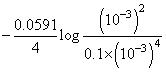 {∴ [H+] = 10-pH}
= 1.67 - 0.106 = 1.57 V
N = 4 (no. of moles of electron involved)
From Nernst′s equation,
Ecell = Eocell
log Q= 1.67
{∴ [H+] = 10-pH}= 1.67 - 0.106 = 1.57 V
Create a free account to view solution
View Solution FreeMore Electrochemistry Questions
The equivalent conductivity (in Ω−1 cm2 eq−1) of 1.0 M – H2SO4 solution of specific conductance 2.6 × 10⁻¹ cm−1, is...The EoM+3/M2+ values for Cr, Mn, Fe and Co are - 0.41, + 1.57, + 0.77 and + 1.97 V respectively. For which one of these ...A current of 2.0 ampere passed for 5 hours through a molten tin salt deposits 22.2 gm of metal. The oxidation number of ...When iron is rusted, it is :...The standard emf of the cell, Cd(s) | CdCl2(aq) (0.1 M) || AgCl(s) | Ag(s) in which the cell reaction is,Cd(s) + 2AgCl(s...