FrictionMedium
Question
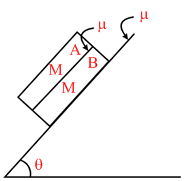
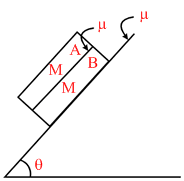
Two identical blocks of same masses are placed on a fixed wedge as shown in figure. Coefficient of friction between all the contact surfaces is μ. Choose the correct alternative
Options
A.For motion at any surface, θ ≤ tan-1 (μ).
B.Acceleration of block A will be more than acceleration of block B in downward direction.
C.Acceleration of block A will be more than acceleration of block B in downward direction.
D.Two blocks A and B moves with same acceleration.
Solution
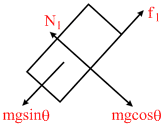
F.B.D. for A block
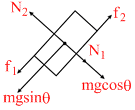
F.B.D. for B block
for block A
mg sinθ − f1 = ma .........(1)
for motion w.r.t. block B
mgsinθ − μmg cosθ = ma .........(2)
for limiting case
a = 0
and a = b = 0
⇒ mg sinθ = μmg cosθ
μ = tanθ
θ = tan-1 μ
for block B
mgsinθ + f1 − f2 = mb
for motion w.r.t wedge
f2 = 2μmg cos θ
mgsinθ + f1 2μmg cosθ = mb ..........(3)
for no relative motion between A and B block from equation (1) & (3) : a = b
2mg sinμ − 2μmg cosθ = 2ma
for limiting case a = 0
⇒ θ = tan-1 (μ)
for motion θ tan-1 (μ)
when block B is moving w.r.t wedge
mgsinθ + f1 − 2μ mgcosθ = mb
But f1 = μmg cosθ ⇒ mg sinθ − μmg cosθ = mb
for block A
mg sinθ − µmgcosθ = ma ⇒ a = b.
Create a free account to view solution
View Solution FreeMore Friction Questions
A box of mass 15 kg is kept on the floor of a stationary trolley. The coefficient of static friction between the box and...A block of mass m placed on a rough inclined plane of inclinationθ = 30o can be just prevented from sliding down by...A solid hemisphere of weight P rests with its curved surface in contact with a rough inclined plane. A weight Q is place...Having been paddled continuously on a horizontally road, the speed of a bicycle is increasing, the force of friction exe...In the given figure the value(s) of mass m for which the 100 kg block remains in static equilibrium is (g = 10 m/s2)...