Set, Relation and FunctionEasy
Question
Let f be a twice differentiable function such that f″(x) = - f(x) and f′(x) = g(x). If h(x) = (f(x))2 + (g(x))2 where h(2) = 2. Then the value of h(1) is
Options
A.1
B.2
C.1/2
D.5
Solution
f″(x) = - f(x)
Multiplying both sides by f′(x), we get
f′(x).f″(x) = - f(x).f′(x).
Integrating
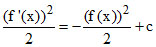
⇒ (f(x))2 + (f′(x))2 = k ⇒ (f(x))2 + (g(x))2 = k
⇒ h(x) = k
∵ h(2) = 2 ⇒ h(x) = 2 ∀ x ⇒ h(1) = 2
Multiplying both sides by f′(x), we get
f′(x).f″(x) = - f(x).f′(x).
Integrating
⇒ (f(x))2 + (f′(x))2 = k ⇒ (f(x))2 + (g(x))2 = k
⇒ h(x) = k
∵ h(2) = 2 ⇒ h(x) = 2 ∀ x ⇒ h(1) = 2
Create a free account to view solution
View Solution FreeMore Set, Relation and Function Questions
Let S be a non-empty subset of R. Consider the following statement: P: There is a rational number x ∈ S such that ...The relation R on the set A = {1, 2, 3} defined by R = {(1, 2), (1, 3)} is...If A = {x|x2 = 4}and B = {x|x2 − 5x + 6 = 0} then A ∪ B...Consider the following relations:R = {(x, y) | x, y are real numbers and x = wy for some rational number w}; S = m, n, p...Let A = {2, 3, 4, 5} and let R = {(2, 2), (3, 3), (4, 4), (5, 5), (2, 3), (3, 2), (3, 5), (5, 3)} be a relation on A. Th...