JEE Advanced | 2014Set, Relation and FunctionMedium
Question
Let f : [a, b] → [1, ∞) be a continuous function and let g : R → R be defined as
g(x) =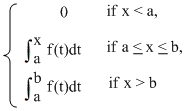 . Then
g(x) =
. ThenOptions
A.g(x) is continuous but not differentiable at a
B.g(x) is differentiable on R
C.g(x) is continuous but not differentiable at b
D.g(x) is continuous and differentiable at either a or b but not both
Solution
g(a-) = 0, g(a) = f(t)dt = 0, g(a+) =
  f(t)dt = 0
g(b-) = f(t)dt =
  f(t)dt
g(b) =f(t)dt = g(b+)
Hence g(x) is continuous at x = a as well as x = b
Now, g′(a-) =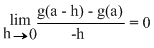
g′(a+) =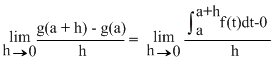
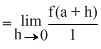 = f(a) (≠ 0)
Hence g(x) is not differentiable at x = a.
g′(b-) = f(b)(≠ 0)
g′(b+)
Hence g(x) is not differentiable at x = b.
f(t)dt = 0, g(a+) = f(t)dt = 0g(b-) =
f(t)dt = f(t)dtg(b) =
f(t)dt = g(b+)Hence g(x) is continuous at x = a as well as x = b
Now, g′(a-) =
g′(a+) =
= f(a) (≠ 0)Hence g(x) is not differentiable at x = a.
g′(b-)
= f(b)(≠ 0)g′(b+)
Hence g(x) is not differentiable at x = b.
Create a free account to view solution
View Solution FreeMore Set, Relation and Function Questions
Let A = {a, b, c, d}, B = {b, c, d, e}. Then n[(A × B) (B × A)] is equal to -...The Range of the fucntion y = is : -...If f : R → R, f(x) = max. {x, x3}, then the set of the points where f is not differentiable is...If A = {1, 2, 3}, B = {1, 4, 6, 9} and R is a relation from A to B defined by ′x is greater than y′. The ran...The range of k for which the inequality k cos2x - k cos x + 1 ≥ 0 ∀ x ∈ R, is -...