Coordination CompoundHard
Question
Which of the following is not correctly matched ?
Options
A.[Fe(en)3]3+ - sp3d2 and paramagnetic
B.[FeCl4]2- - sp3 and paramagnetic
C.[Fe(CN)6]3- - d2sp3 and paramagnetic
D.[Fe(CO)2(NO+)2] - sp3 and diamagnetic
Solution
(A) [Fe(en)3]3+ - d2sp3 with one unpaired electron. ′en′ is a strong field chelating ligand and thus compels for the pairing of electrons to have d2sp3 hybridisation. It is paramagnetic with one unpaired electron (valence shell electron configuration, 3d5)
(B) [FeCl4]2- - sp3 with four unpaired electrons. It is paramagnetic with four unpaired electrons (valence shell electron configuration, 3d6).
(C) [Fe(CN)6]3- - d2sp3 with one unpaired electron. ′CN-′ is a strong field ligand and, therefore, it compels for pairing of electrons to have d2sp3 hybridisation. It is paramagnetic with one unpaired electron (valence shell electron configuration, 3d5)
(D) [Fe(CO)2(NO+)2] - sp3 and diamagnetic. Iron is in -II oxidation state. So,
[Fe(CO)2(NO+)2]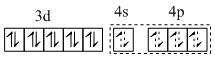
sp3hybridisation
(B) [FeCl4]2- - sp3 with four unpaired electrons. It is paramagnetic with four unpaired electrons (valence shell electron configuration, 3d6).
(C) [Fe(CN)6]3- - d2sp3 with one unpaired electron. ′CN-′ is a strong field ligand and, therefore, it compels for pairing of electrons to have d2sp3 hybridisation. It is paramagnetic with one unpaired electron (valence shell electron configuration, 3d5)
(D) [Fe(CO)2(NO+)2] - sp3 and diamagnetic. Iron is in -II oxidation state. So,
[Fe(CO)2(NO+)2]
sp3hybridisation
Create a free account to view solution
View Solution FreeMore Coordination Compound Questions
What is the shape of Fe(CO)5 molecule ? Given that its dipole moment = 0....The correct order the wavelength of absorption in the visible region is :...The number of unpaired electrons calculated in [Co(NH3)6]3+ and [CoF6]3– are :...Which one of the following has the regular tetrahedral structure?...An ion M2+, forms the complexes [M(H2O)6]2+, [M(en)3]2+ and [MBr6]4–, match the complex with the appropriate colour....