Chemical Kinetics and Nuclear ChemistryEasy
Question
For The Reaction,
N2O5(g) → 2NO2(g) + 1/2 O2(g)
the value of rate of disappearance of N2O5 is given as 6.25 × 10⁻³ mol L-1 s-1. The rate of formation of NO2 and O2 is given respectively as -
N2O5(g) → 2NO2(g) + 1/2 O2(g)
the value of rate of disappearance of N2O5 is given as 6.25 × 10⁻³ mol L-1 s-1. The rate of formation of NO2 and O2 is given respectively as -
Options
A.6.25 × 10-3 mol L-1 s-1 and 6.25 × 10⁻³ mol L-1 s-1
B.1.25 × 10-2 mol L-1 s-1 and 3.125 × 10⁻³ mol L-1 s-1
C.6.25 × 10-3 mol L-1 s-1 and 3.125 × 10⁻³ mol L-1 s-1
D.1.25 × 10-2 mol L-1 s-1 and 3.125 × 10⁻³ mol L-1 s-1
Solution
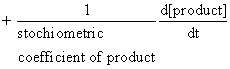
Rate of disappearance of reactant = rate of appearance of products
or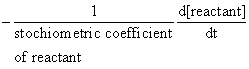
=
For the reaction,
N2O5(g) → 2NO2(g) + 1/2O2

∴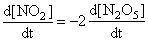
= 2 × 6.25 × 10-3 mol L-1 s-1
= 12.5 × 10⁻³ mol L-1 s-1
= 1.25 × 10--2 mol L-1 s-1
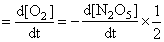
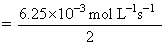
= 3.125 × 10⁻³ mol L-1 s-1
or
=
For the reaction,
N2O5(g) → 2NO2(g) + 1/2O2
∴
= 2 × 6.25 × 10-3 mol L-1 s-1
= 12.5 × 10⁻³ mol L-1 s-1
= 1.25 × 10--2 mol L-1 s-1
= 3.125 × 10⁻³ mol L-1 s-1
Create a free account to view solution
View Solution FreeTopic: Chemical Kinetics and Nuclear Chemistry·Practice all Chemical Kinetics and Nuclear Chemistry questions
More Chemical Kinetics and Nuclear Chemistry Questions
In the reaction N2 + 3H2 ⇋ 2NH3 = 1 × 10² [N2] [H2]3 - 1 × 10⁻³ [NH3]2 and at some instant if = 10-5 M2t...Rate of a reaction can be expressed by Arrhenius equation as: k = A e-E /RT In this equation, E represents...A catalyst :...To very good approximations, the cooling of a hot body to room temperature follows first-order kinetics (in this case, h...X-Rays are emitted during...