Chemical Kinetics and Nuclear ChemistryHard
Question
Read the following industrial methods for the preparation of H2SO4 and answer the question at the end. Professor Molina of the Massachusetts Institute of Technology won the 1995 Nobel Prize in Chemistry for his work on atmospheric chemistry. One reaction that he has studied in detail is the acid rain reaction which produces H2SO4 in the atmosphere. He has proposed two possible stoichiometric reactions :
Proposal A : H2O (g) + SO3(g) → H2SO4(g)
Proposal B : 2 H2O (g) + SO3(g) → H2SO4 (g) + H2O (g)
Using simple collision theory, what reaction orders would be expected for proposal B ?
Proposal B is thought to proceed by the following two-step process :
SO3 + 2 H2O SO3.2 H2O (fast)
SO3.2 H2O H2SO4 + H2O (slow)
(SO3.2 H2O is a complex which is stabilized by hydrogen bonds and k2 << k1 or k-1).
Proposal A : H2O (g) + SO3(g) → H2SO4(g)
Proposal B : 2 H2O (g) + SO3(g) → H2SO4 (g) + H2O (g)
Using simple collision theory, what reaction orders would be expected for proposal B ?
Proposal B is thought to proceed by the following two-step process :
SO3 + 2 H2O
SO3.2 H2O (fast)SO3.2 H2O
H2SO4 + H2O (slow) (SO3.2 H2O is a complex which is stabilized by hydrogen bonds and k2 << k1 or k-1).
Options
A.k [H2O] [SO3]
B.k[H2O]2 [SO3]
C.k [SO3]
D.k[H2O]
Solution
Rate determining step is slow step
Then Rate = k2 [SO3 . 2 H2O] .....(i)
We know by fast equation
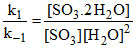
[SO3. 2 H2O] = [SO3] [H2O]2 ....(ii)
put the value of [SO3 . 2 H2O] from (ii) to (i)
Rate = k2 × [SO3 ] [ H2O]2
Rate = k [H2O]2 [SO3]
Then Rate = k2 [SO3 . 2 H2O] .....(i)
We know by fast equation
[SO3. 2 H2O] =
[SO3] [H2O]2 ....(ii)put the value of [SO3 . 2 H2O] from (ii) to (i)
Rate = k2 ×
[SO3 ] [ H2O]2Rate = k [H2O]2 [SO3]
Create a free account to view solution
View Solution FreeTopic: Chemical Kinetics and Nuclear Chemistry·Practice all Chemical Kinetics and Nuclear Chemistry questions
More Chemical Kinetics and Nuclear Chemistry Questions
To very good approximations, the cooling of a hot body to room temperature follows first-order kinetics (in this case, h...The hypothetical reaction : 2A + B → C + D is catalyzed by E as indicated in the possible mechanism below -Step-I ...The reaction A → B follows first order kinetics. The time taken for 0.8 mol of A to produce 0.6 mol of B is 1 hr. ...For the reaction A (g) + 2B(g) → C(g) + D(g) = k [A] [B]2 Initial pressure of A and B are respectively 0.60 atm an...The rate of a reaction A + 2B → P is 2 × 10⁻² M/ min, when concentrations of each A and B are 1.0 M. If the rate of reac...