Chemical Kinetics and Nuclear ChemistryHard
Question
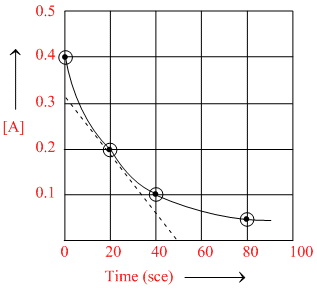
A certain reaction A → B follows the given concentration (Molarity)-time graph. Which of the following statements is/are true ?
Options
A.The reaction is second order with respect to A.
B.The rate for this reaction at 20 s will be 7 × 10⁻³ M s-1.
C.The rate for this reaction at 80 s will be 1.75 × 10⁻³ M s-1.
D.The [B] will be 0.35 M at t = 60 s.
Solution
Use initial rate law method, let the reaction be first order,
So, k =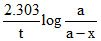
B. At t = 20 s, k1 =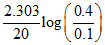 = k1
= k1
⇒ Assumption is correct (k1 = k2)
Rate at 20 s = k[A] = × 0.2
× 0.2
= 0.0063 ≈ 7 × 10⁻³ M s-1
Clearly, half life t1/2 = 20 s
D. In 60 s, number of life = = 3
= 3
⇒ [B] at 60 s
= 0.4 - 0.4 = 0.35 M
So, k =
B. At t = 20 s, k1 =
= k1⇒ Assumption is correct (k1 = k2)
Rate at 20 s = k[A] =
× 0.2= 0.0063 ≈ 7 × 10⁻³ M s-1
Clearly, half life t1/2 = 20 s
D. In 60 s, number of life =
= 3⇒ [B] at 60 s
= 0.4 - 0.4
= 0.35 MCreate a free account to view solution
View Solution FreeTopic: Chemical Kinetics and Nuclear Chemistry·Practice all Chemical Kinetics and Nuclear Chemistry questions
More Chemical Kinetics and Nuclear Chemistry Questions
Inversion of sucrose (C12H22O11) is first-order reaction and is studied by measuring angle of rotation at different inst...Incorrect order of solubility is :...6C12 and 1T3 are formed in nature due to the nuclear reaction of neutron with...For reaction aA → xP, when [A] = 2.2 mM, the rate was found to be 2.4mMs-. On reducing concentration of half, the ...For the second-order reaction 2A → B, time taken for the [A] to fall to one-fourth value is how many times the time it t...