Chemical Kinetics and Nuclear ChemistryHard
Question
A(g) → B(g) + C(g)
 = k [A]
At the start pressure is 100 mm and after 10 min , pressure is 120 mm. hence , rate constant (min-1) is :
= k [A]At the start pressure is 100 mm and after 10 min , pressure is 120 mm. hence , rate constant (min-1) is :
Options
A.
B.
C.
D.
Solution
A(g) → B(g) + C(g)
 = k [A]
A (g) → B (g) + C (g)
100 0 0 t = 0
(100 - P) P P t = 10 min. (feuV)
100 - P + P + P = 120
(100 + P) = 120
Then
k =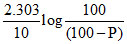
k =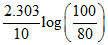
= k [A]A (g) → B (g) + C (g)
100 0 0 t = 0
(100 - P) P P t = 10 min. (feuV)
100 - P + P + P = 120
(100 + P) = 120
Then
k =
k =
Create a free account to view solution
View Solution FreeTopic: Chemical Kinetics and Nuclear Chemistry·Practice all Chemical Kinetics and Nuclear Chemistry questions
More Chemical Kinetics and Nuclear Chemistry Questions
Lyophilic colloids are stable due to:...Which of the following represents the expression for 3/4th the life of a first-order reaction?...Identify compounds readily liberate CO2 gas on heating ?...The specific constant of a first order reaction depends on the :...For the reaction 2N2O5(g) → 4NO2(g) + O2(g), the concentration of NO2 increases by 2.4 × 10⁻² M in 6 s. What will be the...