Chemical Kinetics and Nuclear ChemistryHard
Question
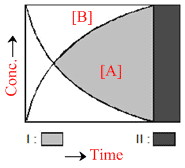
In the following graphical representation for the reaction A → B there are two types of regions :
Options
A.I and II both represent kinetic region at different interval
B.I and II both represent equilibrium regions at different time interval
C.I represents kinetic while II represents equilibrium region
D.I represents equilibrium while II represents kinetic region
Solution
I represent kinetic but II represent equilibrium region
Because at equilibrium the concentration remains constant.
Because at equilibrium the concentration remains constant.
Create a free account to view solution
View Solution FreeTopic: Chemical Kinetics and Nuclear Chemistry·Practice all Chemical Kinetics and Nuclear Chemistry questions
More Chemical Kinetics and Nuclear Chemistry Questions
Which reaction will occur at the fastest rate in water...Which of the following nuclear reactions will generate an isotope?...A zero-order reaction A → B. At the end of 1 h, A is 75% reacted. How much of it will be left unreacted at the end of 2 ...Isomers of hexane, based on their branching, can be divided into three distinct classes as shown in the figure. The corr...At a certain temperature, the first order rate constant k1 is found to be smaller than the second order rate constant k2...