Current Electricity and Electrical InstrumentMedium
Question
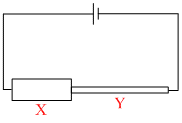
Figure shows a thick copper rod X and a thin copper wire Y, joined in series. They carry a current which is sufficient to make Y much hotter than X. Which one of the following is correct ?Figure shows a thick copper rod X and a thin copper wire Y, joined in series. They carry a current which is sufficient to make Y much hotter than X. Which one of the following is correct ?
Options
A.Density of conduction electrons - Same in X and Y
Mean time between collisions of the electrons - Less in X than Y
Mean time between collisions of the electrons - Less in X than Y
B.Density of conduction electrons - Same in X and Y
Mean time between collisions of the electrons - Same in X and Y
Mean time between collisions of the electrons - Same in X and Y
C.Density of conduction electrons - Same in X and Y
Mean time between collisions of the electrons - More in X than Y
Mean time between collisions of the electrons - More in X than Y
D.Density of conduction electrons - More in X than Y
Mean time between collisions of the electrons - Less in X than Y
Mean time between collisions of the electrons - Less in X than Y
Solution
The number density n of conduction electrons in the copper is a characteristic of the copper and is about 1029 at room temperature for both the copper rod X and the thin copper wire Y.
Both X and Y Carry the same current I since they are joined in series. From I = neAvd.
We may conclude that rod X has a lower drift velocity of electrons compared to wire Y since rod X has larger cross-sectional area. This is so because the electrons in X collide more often with one another and with the copper ions when drifting towards the positive end. Thus, the mean time between collisions of the electrons is more in X and than than in Y.
Both X and Y Carry the same current I since they are joined in series. From I = neAvd.
We may conclude that rod X has a lower drift velocity of electrons compared to wire Y since rod X has larger cross-sectional area. This is so because the electrons in X collide more often with one another and with the copper ions when drifting towards the positive end. Thus, the mean time between collisions of the electrons is more in X and than than in Y.
Create a free account to view solution
View Solution FreeTopic: Current Electricity and Electrical Instrument·Practice all Current Electricity and Electrical Instrument questions
More Current Electricity and Electrical Instrument Questions
Equivalent resistance of series combination -...A galvanometer of resistance $100\Omega$ gives full scale deflection for a current of 1 mA . It is converted into an amm...A piece of copper and another of germanium are cooled from room temperature to 80 K. The resistance of :...20% of the main current passes through the galvanometer. If the resistance of the galvanometer is G, then the resistance...A wire of length ' $l$ ' and resistance $100\Omega$ is divided into 10 equal parts. The first 5 parts are connected in s...