Atomic StructureHard
Question
A electron in the hydrogen atom jumped from excited state n to the ground state. The wavelength so emitted illuminates a photosensitive material having work function 2.75 eV. If the stopping potential of the photoelectron is 10 V, then the value of n is
Options
A.2
B.3
C.4
D.5
Solution
Here, stopping potential, V0 = 10V
Work function, W = 2.75 eV
According to Einstein′s photoelectric equation

or
= 10 eV + 2.75 eV = 12.75 eV ...... (i)
When an electron in the hydrogen atom makes a transition from excited state n to the ground state (n = 1), then he frequency ( ) of the emitted photon is given by
h = En - E1
h = - 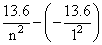
[∵ For hydrogen atom, En = ]
]
According to the given problem
 + 13.6 = 12.75 [Using (i)]
 = 0.85 ⇒ n2 =
or n = 4
Work function, W = 2.75 eV
According to Einstein′s photoelectric equation
or
= 10 eV + 2.75 eV = 12.75 eV ...... (i)
When an electron in the hydrogen atom makes a transition from excited state n to the ground state (n = 1), then he frequency (
) of the emitted photon is given by h
= En - E1h
= - [∵ For hydrogen atom, En =
]According to the given problem
+ 13.6 = 12.75 [Using (i)] = 0.85 ⇒ n2 = or n = 4
Create a free account to view solution
View Solution FreeMore Atomic Structure Questions
An alphanucleus of energy 1/2 mv2 bombards a heavy nuclear target of charge Ze. Then the distance of closest approach fo...Let n1 be the frequency of the series limited of the Lyman series, ν2 be the frequency of the first line of the Lym...An energy of 24.6 eV is required to remove one of the electrons forms a neutral from a neutral helium atom The energy (I...Which energy state of doubly ionized lithium (Li++) has the same energy as that of the ground state of hydrogen ? Given ...The magnetic moment (μ) of a revolving electron around the nucleus varies with principal quantum number n as :...