ThermodynamicsMedium
Question
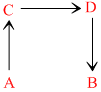
The direct conversion of A to B is difficult, hence it is carried out by the following shown path:
Given ᐃS(A → C) = 50 e.u.
ᐃS(C → D) = 30 e.u.
ᐃS(B → D) = 20 e.u.
where e.u. is entropy unit then ᐃS(A → B) is
Given ᐃS(A → C) = 50 e.u.
ᐃS(C → D) = 30 e.u.
ᐃS(B → D) = 20 e.u.
where e.u. is entropy unit then ᐃS(A → B) is
Options
A.+ 100 e.u.
B.+ 60 e.u.
C.- 100 e.u.
D.- 60 e.u.
Solution
ᐃS(A → B) = ᐃS(A → C) + ᐃS(C → D) - ᐃS(B → D) = 50 + 30 - 20
Create a free account to view solution
View Solution FreeMore Thermodynamics Questions
If one mole of a monoatomic gas ($\gamma$ = 5/3) is mixed with one mole of a diatomic gas ($\gamma$ = 7/5), then the val...The values of ΔG are very important in metallurgy. The ΔG values for the following reactions at 1000 K are given as foll...One mole of an ideal gas at 300 K is expended isothermally from an initial volume of 1 liter to 10 liters. The value of ...In a fuel cell methanol is used as fuel and oxygen gas is used as an oxidizer. The reaction is - CH3OH(l) + O2(g) →...What is the efficiency of a cycle consisting of two isochoric and two adiabatic lines, if the volume of the ideal gas ch...