Nuclear Physics and RadioactivityMedium
Question
The above is a plot of binding energy per nucleon Eb, against the nuclear mass M; A, B, C, D, E, F correspond to different nuclei. Consider four reactions:
(i) A + B → C + ε
(ii) C → A + B + ε
(iii) D + E → F + ε
(iv) F → D + E + ε
where ε is the energy released? In which reactions is ε positive?
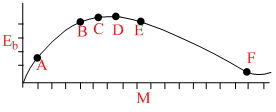
(i) A + B → C + ε
(ii) C → A + B + ε
(iii) D + E → F + ε
(iv) F → D + E + ε
where ε is the energy released? In which reactions is ε positive?
Options
A.(i) and (iv)
B.(i) and (iii)
C.(ii) and (iv)
D.(ii) and (iii)
Solution
1st reaction is fusion and 4th reaction is fission.
Create a free account to view solution
View Solution FreeMore Nuclear Physics and Radioactivity Questions
In a sample, ratio of p31 and p32 is 1 : 2. P31 is stable but p32 is radioactive and decays in S32 with half life T. Aft...When radioactive substance emits an α - particle, then its position in the periodic in the periodic table is lowere...Assume that a neutron breaks into a proton andan electron. The energy released during thisprocess is : (Mass of neutron ...A certain mass of Hydrogen is changed to Helium by the process of fusion. The mass defect in fusion reaction is 0.02866 ...The binding energy per nucleon of deuteron and helium nucleus is 1.1 MeV and 7 MeV respectively. If two deuteron nuclei ...