Circular MotionMedium
Question
Three point particles P, Q, R move in a circle of radius ′r′ with different but constant speeds. They start moving at t = 0 from their initial positions as shown in the figure. The angular velocities (in rad/sec) of P, Q and R are 5π, 2π & 3π respectively, in the same sense. The time interval after which they all meet is:
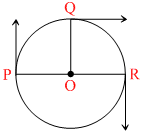
Options
A.2/3 sec
B.1/6 sec
C.1/2 sec
D.3/2 sec
Solution
ωQP = 2π − 5π = − 3π rad/s
ωRP = 3π − 5π = − 2π rad/s
Time when Q particle reaches at P = t1 = =
 sec.
t2 = =
 sec.
t3 = =
 sec
Time where R particle reaches at P. t1 = =
 sec.
t2 = =
 sec.
Common time to reaches at P is sec. Ans. ωQP = 2π − 5π = − 3π rad/s
ωRP = 3π − 5π = − 2π rad/s
Time when Q particle reaches at P = t1 = = sec.
t2 = = sec.
t3 = = sec
Time where R particle reaches at P. t1 = = sec.
t2 = = sec.
Common time to reaches at P is sec. Ans.
ωRP = 3π − 5π = − 2π rad/s
Time when Q particle reaches at P = t1 =
= sec.t2 =
= sec.t3 =
= secTime where R particle reaches at P. t1 =
= sec.t2 =
= sec. Common time to reaches at P is
sec. Ans. ωQP = 2π − 5π = − 3π rad/sωRP = 3π − 5π = − 2π rad/s
Time when Q particle reaches at P = t1 =
= sec.t2 =
= sec.t3 =
= secTime where R particle reaches at P. t1 =
= sec.t2 =
= sec. Common time to reaches at P is
sec. Ans. Create a free account to view solution
View Solution FreeMore Circular Motion Questions
A particle is going with constant speed along a uniform helical and spiral path separately as shown in figure...The maximum speed of a car on a road turn of radius 30 m; if the coefficient of friction between the tyres and the road ...A coin is thrown off from a gramophone record with coefficient of friction 0.4 when it makes 50 rpm. If an identical coi...A particle is projected horizontally from the top of a tower with a velocity v0. If v be its velocity at any instant, th...A particle is acted upon by a force of constant magnitude which is always perpendicular to the velocity of the particle,...