FunctionHard
Question
Let (x0, y0) be solution of the following equations
(2x)ln2 = (3y)ln3
3lnx = 2lny
Then x0 is
(2x)ln2 = (3y)ln3
3lnx = 2lny
Then x0 is
Options
A.1/6
B.1/3
C.1/2
D.6
Solution
(2x)ln2 = (3y)ln3 .........(i)
3lnx = 2lny .........(ii)
⇒ (log x) (log 3) = (log y) (log 2)
⇒ log y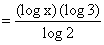 .........(iii)
In (i) taking log both sides
(log 2) {log 2 + log x} = log3{log 3 + log y}
(log 2)2 + (log 2) (log x) = (log 3)2 +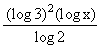 from (iii)
⇒ (log 2)2 - (log 3)2 =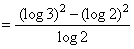 (log x) ⇒ - log 2 = log x
⇒ x = 1/2 ⇒ x0 = 1/2
3lnx = 2lny .........(ii)
⇒ (log x) (log 3) = (log y) (log 2)
⇒ log y
.........(iii)In (i) taking log both sides
(log 2) {log 2 + log x} = log3{log 3 + log y}
(log 2)2 + (log 2) (log x) = (log 3)2 +
from (iii)⇒ (log 2)2 - (log 3)2 =
(log x) ⇒ - log 2 = log x⇒ x = 1/2 ⇒ x0 = 1/2
Create a free account to view solution
View Solution FreeMore Function Questions
Let g(x) = 1 + x -[x] and f(x) = , then for all x, f [g(x)] is equal to...If f(x) = = y, (a ≠ c), then f(y) equals to...If f(x) = sgn , where [.] is the greatest integer function, then which of the following statement is/are true ?...Which of the following function has a period of 2π ?...Let f(x) = - {x}, the range of f(x) is given by (where {.} represents fractional part of x)...