FunctionEasy
Question
If f(x) = sgn 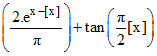 , where [.] is the greatest integer function, then which of the following statement is/are true ?
, where [.] is the greatest integer function, then which of the following statement is/are true ?Options
A. f(x) = 1
f(x) = 1B.Range of f(x) contains only one integer
C.f(x) is periodic function.
D.The equation f(x) = 1 +  x2 dt has infinitely many non-integral roots.
x2 dt has infinitely many non-integral roots.Solution
f(x) = sgn
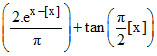 .
.domain of the function is x ∈ [2n, 2n+1) where
n ∈ I. and tan
 = 0 ⇒ ∀ x ∈ [2n,2n + 1)
and sgn
 = 1 for x in domain
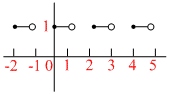
∴ f(x) = 1 ∀ x ∈ [2n, 2n + 1) graph of y = f(x)
Also, f(x) = 1 +
 x2dt = 1 + x2 - 1
⇒ x2 = 0
⇒ x = 0 only one root.
Create a free account to view solution
View Solution FreeMore Function Questions
If f : R → R , f(x) = sin2 x + cos2 x , then f is -...If f(x) is negative & 2f(sinx) + √2 f(-cosx) = - tanx,then value of f (1/2) is...If f : I → I, f(x) = x2 − x, then f is -...Which of the following functions from Z to itself are bijections ?...The image of the interval R under the mapping f: R → R given by f(x) = cot-1 (x2 - 4x + 3) is...