CapacitanceMedium
Question
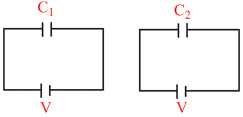
Capacitor C1 of the capacitance 1 microfarad and capacitor C2 of capacitance 2 microfarad are separately charged fully by a common battery. The two capacitors are then separately allowed to discharge through equal resistors at time t = 0.
Options
A.the current in each of the two discharging circuits is zero at t = 0.
B.the current in the two discharging circuits at t = 0 are equal but non zero.
C.the current in the two discharging circuits at t = 0 are unequal
D.capacitor C1 loses 50% of its initial charge sooner than C2 loses 50% of its initial charge
Solution
During decay of charge in RC circuit
I = I0e−t/RC
where
when t = 0, I =
Since potential difference between the plates is same initially therefore I same in both the cases at t = 0 and is equal to
Also
Also q = q0e−t/RC. When q = then
then  = q0e−t/RC
⇒ e+t/RC = 2. = ln2
= ln2
⇒ t = RC loge 2
⇒ t ∞ C. Therefore time taken for the first capacitor (1μF) for discharging 50% of Initial charge will be less.
(B), (D) are the correct options.
I = I0e−t/RC
where
when t = 0, I =
Since potential difference between the plates is same initially therefore I same in both the cases at t = 0 and is equal to
Also
Also q = q0e−t/RC. When q =
then = q0e−t/RC ⇒ e+t/RC = 2.
= ln2⇒ t = RC loge 2
⇒ t ∞ C. Therefore time taken for the first capacitor (1μF) for discharging 50% of Initial charge will be less.
(B), (D) are the correct options.
Create a free account to view solution
View Solution FreeMore Capacitance Questions
The energy density in a parallel plate capacitor is given as 2.1 × 10⁻⁹ J/m3. The value of the electric field...The plates of a parallel plate capacitor are separated by $d$. Two slabs of different dielectric constant $K_{1}$ and $K...When two capacitors are charged to different potentials and then connected in parallel to each other, then :-...An air capacitor of capacity C = 10 μF is connected to a constant voltage battery of 12 V. Now the space between th...A conducting wire of length l and mass m can slide without friction on two parallel rails and is connected to capacitanc...