JEE Advanced | 2015Chemical BondingHard
Question
The correct statement(s) regarding, (i) HClO, (ii) HClO2, (iii) HClO3 and (iv) HClO4, is(are)
Options
A.The number of Cl = O bonds in (ii) and (iii) together is two
B.The number of lone pairs of electrons on Cl in (ii) and (iii) together is three
C.The hybridization of Cl in (iv) is sp3
D.Amongst (i) to (iv), the strongest acid is (i)
Solution
Structure of
(i) HClO =
(ii) HClO2 =
(iii) HClO3 =
(iv) HClO4 =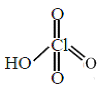
(A) The number of Cl = O bonds in (ii) and (iii) together is three
(B) The number of lone pairs of electrons on Cl in (ii) and (iii) together is three
(C) The hybridisation of Cl in (iv) is sp3
(D) Amongst (i) to (iv) the strongest acid is (iv) HClO4
(i) HClO =
(ii) HClO2 =
(iii) HClO3 =
(iv) HClO4 =
(A) The number of Cl = O bonds in (ii) and (iii) together is three
(B) The number of lone pairs of electrons on Cl in (ii) and (iii) together is three
(C) The hybridisation of Cl in (iv) is sp3
(D) Amongst (i) to (iv) the strongest acid is (iv) HClO4
Create a free account to view solution
View Solution FreeMore Chemical Bonding Questions
Bond order of 1.5 is shown by:...The first ionisation energy of Na, NO, Xe and O2 follows the order Na 2 .O2 reacts with powerful oxidising agent (PtF6) ...Magnetic moment 2.83 BM is given by which of the following ions ? (At. nos. Ti = 22, Cr = 24, Mn = 25, Ni = 28).......................(1) ....................(2)If both the reaction shows kinetic isotope effect then...The bond dissociation energy of B - F in BF3 is 646 kJ mol-1 whereas that of C-F in CF4 is 515kJ mol-1. The correct reas...