Trigonometric EquationHard
Question
For a positive integer n let (fn(θ) (1 + sec θ)(1 + sec 2θ)(1 + sec 22θ)...(1+ sec 2nθ), then
(1 + sec θ)(1 + sec 2θ)(1 + sec 22θ)...(1+ sec 2nθ), thenOptions
A.f2 = 1
= 1
= 1B.f3 = 1
= 1
= 1C.f4 = 1
= 1
= 1D.f5 = 1
= 1
= 1Solution
Note Multiplicative loop is very important approach in IIT Mathematics.
Now, (1 + sec θ) =
 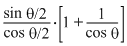 0
0
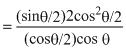
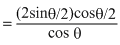

∴ fn(θ) = (tan θ / 2)(1 + sec θ)
(1 + sec 2θ)(1 + sec 22θ)...(1+ sec 2nθ)
= (tan θ)(1 + sec 2θ)(1 + sec 22θ)...(1 + sec 2nθ)
= tan 2θ.(1 + sec 22θ)...(1 + sec 2nθ)
.........................................................
.........................................................
= tan(2nθ)
Now,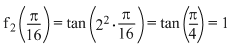
Therefore, (a) is the answer.
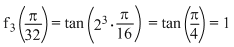
Therefore, (b) is the answer.
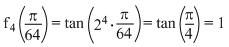
Therefore, (c) is the answer.

Therefore, (d) is the answer.
Now,
(1 + sec θ) = 0 ∴ fn(θ) = (tan θ / 2)(1 + sec θ)
(1 + sec 2θ)(1 + sec 22θ)...(1+ sec 2nθ)
= (tan θ)(1 + sec 2θ)(1 + sec 22θ)...(1 + sec 2nθ)
= tan 2θ.(1 + sec 22θ)...(1 + sec 2nθ)
.........................................................
.........................................................
= tan(2nθ)
Now,
Therefore, (a) is the answer.
Therefore, (b) is the answer.
Therefore, (c) is the answer.
Therefore, (d) is the answer.
Create a free account to view solution
View Solution Free