Application of DerivativeMedium
Question
Let f(x) = 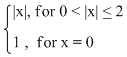 Then, at x = 0, f has
Then, at x = 0, f hasOptions
A.a local maximum
B.no local maximum
C.a local minimum
D.no extremum
Solution
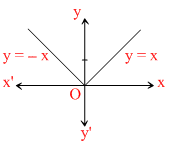
It is clear from figure that at x = 0. f (x) is not continuous.
Hence, f has no extremum at x = 0
Create a free account to view solution
View Solution FreeMore Application of Derivative Questions
At what point the slope of the tangent to the curve x2 + y2 - 2x - 3 = 0 is zero -...The slope of the curve y = sin x + cos2x is zero at the point, where -...The function f(x) = t(et - 1)(t - 1)(t - 2)3(t - 3)5dt minimum at x equals to...If a1, a2 ........ an ∈ R+ and a1, a2 .......an = 1 then the least value of (1 + a1 + a21 ) (1 + a2 + a22 )....(1 ...If x = t2 and y = 2t, then equation of normal at t = 1 is-...