Application of DerivativeHard
Question
For the function f(x) = x cot-1x, x ≥ 0
Options
A.there is atleast one x ∈ (0, 1) for which cot-1x = 
B.for atleast one x in the internal (0, ∞), f -f(x) < 1
-f(x) < 1C.number of solution of the equation f(x) = sec x is 1
D.f′(x) is strictly decreasing is the internal (0, ∞)
Solution
f(0) = 0 ≠ f(1)
there will be no x ∈ (0, ∈) (∴ Rolle′s theorem is not applicable)
for which f′(x) = 0 i.e, cot-1 x =
f′(x) ∝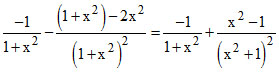
f″(x) =
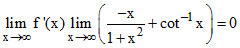
f(0+) =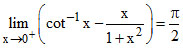
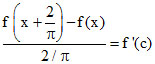 c ∈
c ∈  (∴ lmvt is applicable)
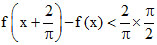
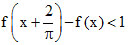
f′(x) ≥ 0; f(x) is increasing
∴ f(x) ∈ [f(0), f(∞))
f(0) = 0

=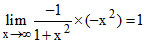
f(x) ∈ [0, 1)
f(x) = sec x will have no solution
there will be no x ∈ (0, ∈) (∴ Rolle′s theorem is not applicable)
for which f′(x) = 0 i.e, cot-1 x =
f′(x) ∝
f″(x) =
f(0+) =
c ∈ (∴ lmvt is applicable)f′(x) ≥ 0; f(x) is increasing
∴ f(x) ∈ [f(0), f(∞))
f(0) = 0
=
f(x) ∈ [0, 1)
f(x) = sec x will have no solution
Create a free account to view solution
View Solution FreeMore Application of Derivative Questions
If the line ax + by + c = 0 is a normal to the curve xy = 1, then-...At what point the tangent line to the curve y = cos(x + y), (-2π ≤ x ≤ 2π) is parallel to x + 2y =...The number of critical points of the function$f(x) = \left\{ \begin{matrix} \left| \frac{sinx}{x} \right|, & x \neq ...If x1 and x2 are abscissa of two points on the curve f(x) = x - x2 in the interval [0, 1], then maximum value of the exp...If f(x) = a{a|x|sin x}; g(x) = a[a|x|sin x] for a > 1, a ≠ 1and x ∈ R, where { } & [ ] denote the fractio...