Application of DerivativeHard
Question
The maximum value of (cos α1).(cos α2) ...... (cos αn) under the restrictions 0 ≤ α1, α2, ...., αn ≤  and (cot α1).(cotα2)....(cotαn) = 1 is
and (cot α1).(cotα2)....(cotαn) = 1 isOptions
A.
B.
C.
D.1
Solution
Given, cot α1. cot α2 .... cot αn = 1
⇒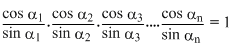
⇒ Let cos α1.cos α2.cos α3 .... cos αn = k .....(i)
and sin α1. sin α2. sin α3 ....sin αn = k .....(ii)
Again, multiply Eqs (i) and (ii), we get
(cos α1 . cos α2. cos α3 ... cos αn) × (sin α1. sin α2. sin α3 ....sin αn) = k2
k2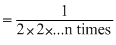 (2 sin α1 cos α1) (2sin α2 cos α2)...(2sin αn cos αn)
⇒ k2 = (sin 2 α1) (sin 2α2) ...(sin 2αn)
≤ sin 2 αi ≤ 1 for all 1 ≤ i < n
⇒ k ≤
⇒
⇒ Let cos α1.cos α2.cos α3 .... cos αn = k .....(i)
and sin α1. sin α2. sin α3 ....sin αn = k .....(ii)
Again, multiply Eqs (i) and (ii), we get
(cos α1 . cos α2. cos α3 ... cos αn) × (sin α1. sin α2. sin α3 ....sin αn) = k2
k2
(2 sin α1 cos α1) (2sin α2 cos α2)...(2sin αn cos αn)⇒ k2 =
(sin 2 α1) (sin 2α2) ...(sin 2αn)≤
sin 2 αi ≤ 1 for all 1 ≤ i < n⇒ k ≤
Create a free account to view solution
View Solution FreeMore Application of Derivative Questions
If the line ax + by + c = 0 is a normal to the curve xy = 1, then-...Let f and g be increasing and decresing functions respectively from [0, ∞) to [0, ∞) Let h(x) = f (g(x)). If...A kite is 300 m high and there are 500 m of cord out. If the wind moves the kite horizontally at the rate of 5 km/hr. di...Let Tr be the rth term of an A.P. for r = 1, 2, 3, ........ If for some positive integers m, n we have Tm = & Tn = , the...A tangent drawn to the curve y = f(x) at P(x, y) cuts the x-axis and y-axis at A and B respectively such that BP : AP = ...