Current Electricity and Electrical InstrumentEasy
Question
Figure shows a thick copper rod X and a thin copper wire Y, joined in series. They carry a current which is sufficient to make Y much hotter than X. Which one of the following is correct?
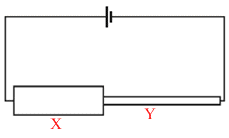
Options
A.Same in X and Y Less in X than Y
B.Same in X and Y Same in X and Y
C.Same in X and Y More in X than Y
D.More in X than Y less in X than Y
Solution
The number density n of conduction electrons in the copper is a characteristic of the copper and is about 1029 at room temperature for both the copper rod X and the thin copper wire Y.
Both X and Y carry the same current I since they are joined in series.
From I = neAvd
We may conclude that rod X has a lower drift velocity of electrons compared to wire Y since rod X has larger cross-sectional area. This is so because the electrons in X collide more often with one another and with the copper ions when drifting towards the positive end. Thus, the mean time between collisions of the electrons is more in X and than in Y.
Both X and Y carry the same current I since they are joined in series.
From I = neAvd
We may conclude that rod X has a lower drift velocity of electrons compared to wire Y since rod X has larger cross-sectional area. This is so because the electrons in X collide more often with one another and with the copper ions when drifting towards the positive end. Thus, the mean time between collisions of the electrons is more in X and than in Y.
Create a free account to view solution
View Solution FreeTopic: Current Electricity and Electrical Instrument·Practice all Current Electricity and Electrical Instrument questions
More Current Electricity and Electrical Instrument Questions
Two heating coils, one of fine wire and the other of thick wire made of same material and of same length are connected i...If the position of an ideal voltmeter and the ideal ammeter are inter changed in a D.C. circuit, then...In the given potentiometer circuit length of the wire AB is 3m and resistance is R = 5Ω. The length AC for no defle...The resistances in the two arms of the meter bridge are 5 Ω and R Ω , respectively. When the resistance R is s...Shown in the figure below is a meter-bridge set up with null deflection in the galvanometer. The value of the unknown re...