Continuity and DifferentiabilityMedium
Question
If f(x) 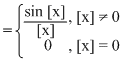
where [x] denotes the greatest integest less than or equal to x, then f(x) equals
where [x] denotes the greatest integest less than or equal to x, then
f(x) equalsOptions
A.1
B.0
C.- 1
D.None of these
Solution
Since, f(x)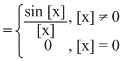
⇒ f(x)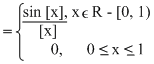
At x = 0
RHL = 0 = 0
0 = 0
and LHL
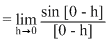
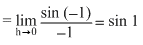
Since, RHL ≠ LHL
∴ Limit does not exist.
⇒ f(x)
At x = 0
RHL =
0 = 0and LHL
Since, RHL ≠ LHL
∴ Limit does not exist.
Create a free account to view solution
View Solution Free