Continuity and DifferentiabilityHard
Question
For a real number y, let [y] denotes the greatest integest integer less than or equal to y Then, the function f(x)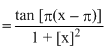 is
is
is Options
A.discontinuous at some x
B.continuous at all x, but the derivative f′(x) does not exist for some x
C.f′(x) exists for all x, but the derivative f′′(x) does not exist for some x
D.f′(x) exists for all x,
Solution
Here, f(x) 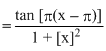
Since ,we know π[(x - π)] = nπ and tan nπ = 0
∵ 1 + [x]2 ≠ 0
∴ f(x) = 0 for all x
Thus, f(x) is a constant function.
∴ f′(x), f′′(x) ..... all exist for every x, their value being 0.
⇒ f′(x) exists for all x.
Since ,we know π[(x - π)] = nπ and tan nπ = 0
∵ 1 + [x]2 ≠ 0
∴ f(x) = 0 for all x
Thus, f(x) is a constant function.
∴ f′(x), f′′(x) ..... all exist for every x, their value being 0.
⇒ f′(x) exists for all x.
Create a free account to view solution
View Solution FreeMore Continuity and Differentiability Questions
If y = a sin-1 x + (sin-1 x)2, where a is a constant, then the value of y2 is -...The number of points in the interval (0,2) where the derivative of the function f(x) = |x − 1/2| + |x − 1| +...If f(x) = ,(x ≠ 0) is continuous everywhere, then f(0) equals-...If f(x) is continuous and g(x) is discontinuous function, then f(x) + g(x) is-...If f(x) = , then f(x) is-...