Continuity and DifferentiabilityHard
Question
If f(x) =  x - 1, then on the interval [0, π]
x - 1, then on the interval [0, π]Options
A.tan [f(x)] and 1/f(x) are both continuous
B.tan [f(x)] and 1/ f(x) are both discontinuous
C.tan [f(x)] and f-1(x) are both continuous
D.tan [f(x)] is continuous but 1/ f(x) is not continuous
Solution
Given, f(x) = x - 1 for 0 ≤ x ≤ π
∴ [f(x)] =
⇒ tan [f(x)] =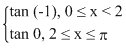
∴ tan [f(x)] = - tan 1
and tan[f(x)] = 0
So, tan f(x) is not continuous at x = 2
Now, f(x) = x - 1
x - 1
⇒ f(x) =
⇒
Clearly, 1/ f(x) is not continuous at x = 2
So, tan [f(x)] and tan are both discontinuous at x = 2
x - 1 for 0 ≤ x ≤ π ∴ [f(x)] =
⇒ tan [f(x)] =
∴
tan [f(x)] = - tan 1 and
tan[f(x)] = 0 So, tan f(x) is not continuous at x = 2
Now, f(x) =
x - 1⇒ f(x) =
⇒
Clearly, 1/ f(x) is not continuous at x = 2
So, tan [f(x)] and tan
are both discontinuous at x = 2Create a free account to view solution
View Solution FreeMore Continuity and Differentiability Questions
If y2 = p(x) is a polynomial of degree 3, then 2 is equal to -...If y = f and f′(x) = sinx2, then is equal to-...If x3 - y3 + 3xy2 - 3x2y + 1 = 0 , then at (0, 1) equals -...Let $f: \mathbb{R} \rightarrow (0,\infty)$ be a twice differentiable function such that $f(3) = 18$, $f'(3) = 0$, and $f...equals, if - 1 < x < 1...