Nuclear Physics and RadioactivityMediumBloom L4
Question
A radioactive sample consists of two distinct species having equal number of atoms initially. The mean life of one species is $\tau$ and that of the other is $5\tau$. The decay products in both cases are stable. A plot is made of the total number of radioactive nuclei as a function of time. Which of the following figures best represents the form of this plot?
Options
A.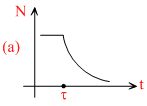
B.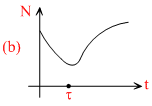
C.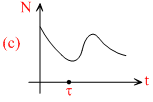
D.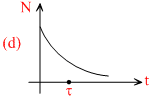
Solution
{"given":"Two radioactive species, each with initial number $N_0$. Mean lives: $\\tau_1 = \\tau$ and $\\tau_2 = 5\\tau$. Total number of radioactive nuclei: $$N(t) = N_0\\,e^{-t/\\tau} + N_0\\,e^{-t/5\\tau}$$","key_observation":"Since both species undergo radioactive decay, $N(t)$ is always decreasing. The rate $\\frac{dN}{dt} = -N_0\\left(\\frac{1}{\\tau}e^{-t/\\tau} + \\frac{1}{5\\tau}e^{-t/5\\tau}\\right)$ is always negative, so the total count can never remain constant or increase.","option_analysis":[{"label":"(A)","text":"Graph showing the total number of nuclei remaining constant over time","verdict":"incorrect","explanation":"A constant plot would imply no decay, which contradicts the exponential decay law. $\\frac{dN}{dt}$ is always negative."},{"label":"(B)","text":"Graph showing the total number of nuclei increasing at some point","verdict":"incorrect","explanation":"The total number can never increase since both decay products are stable and no new radioactive nuclei are produced."},{"label":"(C)","text":"Graph showing the total number of nuclei increasing at some point","verdict":"incorrect","explanation":"Same reasoning as (B) — an increase in radioactive nuclei is physically impossible here since all decay products are stable."},{"label":"(D)","text":"Graph showing a continuously and smoothly decreasing curve from $2N_0$ approaching zero","verdict":"correct","explanation":"The total $N(t) = N_0(e^{-t/\\tau} + e^{-t/5\\tau})$ starts at $2N_0$, decreases monotonically, is concave upward (since $\\frac{d^2N}{dt^2} > 0$), and asymptotically approaches zero."}],"answer":"(D)","formula_steps":[]}
Create a free account to view solution
View Solution FreeMore Nuclear Physics and Radioactivity Questions
A freshly prepared radioactive source of half-life 2 h emits radiation of intensity which is 64 times the permissible sa...adius of nucleus varies as R = R0(A)1/3, where R0 = 1.3 fermi. What is the volume of Be8 nucleus (approx) [A = atomic ma...Probability of remains active of a nucleus in one mean life is :-...In an α-decay the kinetic energy of α-particle is 48 MeV and Q - value of the reaction is 50 MeV. The mass num...he decay constant of radioactive sample is λ. The half-life and mean-life of the sample are respectively given by...