KTGEasy
Question
An ideal gas is initially at temperature T and volume V. Its volume is increased by ᐃV due to an increase in temperature ᐃT, pressure remaing constant. The quantity δ = ᐃV /VᐃT varies with temperature as
Options
A.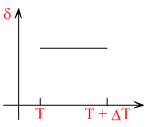
B.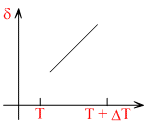
C.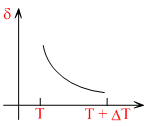
D.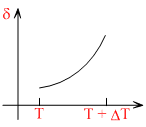
Solution
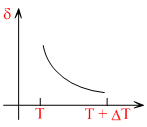
For an ideal gas : pV = nRT
For p = constant
pᐃV = nRTᐃT
∴
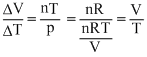
∴
 or δ =
Therefore, δ is inversly proportional to temperature T. i.e., when T increase, δ decrease and vice-versa.
Hence, δ-T grapgh will be a rectangular hyperbola as shown in the above figure.
Create a free account to view solution
View Solution FreeMore KTG Questions
At what temperature is the r.m.s. velocity of a hydrogen molecule equal to that of an oxygen molecule at 47o C?...Gas exerts pressure on the walls of container because the molecules -...From the following statements concerning ideal gas at any given temperature T, select the correct one (s)...The thermodynamic co-ordina tes of a jar filled with gas A are P, V and T and another jar B filled with another gas are ...5n, n and 5n moles of a monoatomic, diatomic and non - linear polyatomic gases (which do not react chemically with each ...