Quadratic EquationEasy
Question
If roots of x2 - (a - 3) x + a = 0, are such that at least one of them is greater than 2, then :-
Options
A.a ∈ [7, 9]
B.a ∈ [7, ∞)
C.a ∈ [9, ∞)
D.a ∈ [7, 9)
Solution
x2 - (a - 3) x + a = 0
two possibler : -
Case-1 one root > 2
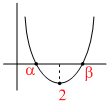
f(2) < 0
4 - (a - 3) × 2 + a < 0
a > 10
Case-2 D ≥ 0 (for real roots)
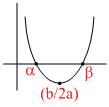
(a - b)2 - 4a ≥ 0
a2 - 10a + a ≥ 0
a ∈ (-∞, 1] ∪ [a, ∞)
⇒ bot roots greaser then 2
f(2) ≥ 0 → a ≤ 10
⇒ minima i.e. - > 2
> 2
+ > 2
> 2
a > 1
one solution will be union of both cases and D ≥ 0
so a ∈ [a, 10) ∪ (10, ∞)
a ∈ [a, ∞)
two possibler : -
Case-1 one root > 2
f(2) < 0
4 - (a - 3) × 2 + a < 0
a > 10
Case-2 D ≥ 0 (for real roots)
(a - b)2 - 4a ≥ 0
a2 - 10a + a ≥ 0
a ∈ (-∞, 1] ∪ [a, ∞)
⇒ bot roots greaser then 2
f(2) ≥ 0 → a ≤ 10
⇒ minima i.e. -
> 2+
> 2a > 1
one solution will be union of both cases and D ≥ 0
so a ∈ [a, 10) ∪ (10, ∞)
a ∈ [a, ∞)
Create a free account to view solution
View Solution FreeMore Quadratic Equation Questions
If x is the real, then the value of the expression is -...Roots of the equation are-...Let $a,b \in C$. Let $\alpha,\beta$ be the roots of the equation $x^{2} + ax + b = 0$. If $\beta - \alpha = \sqrt{11}$ a...Roots of 3x + 3−x = 10 / 3 are-...The roots of the equation (x + 2)2 = 4 (x + 1) − 1 are -...