Chemical Kinetics and Nuclear ChemistryEasy
Question
Consider the chemical reaction,
N2(g) + 2H2(g) → 2NH3(g)
The rate of this reaction can be expressed in terms of time derivatives of concentration of
N2(g), H2(g), or NH3(g). Identify the correct relationship amongst the rate expressions :
N2(g) + 2H2(g) → 2NH3(g)
The rate of this reaction can be expressed in terms of time derivatives of concentration of
N2(g), H2(g), or NH3(g). Identify the correct relationship amongst the rate expressions :
Options
A.Rate = 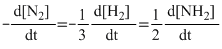
B.Rate = 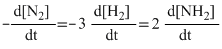
C.Rate = 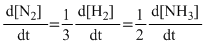
D.Rate = 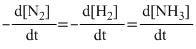
Solution
For a general reaction, aA + bB → cC + dD
Rate =
N2 + 3H2 → 2NH3
Rate =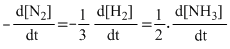
Rate =
N2 + 3H2 → 2NH3
Rate =
Create a free account to view solution
View Solution FreeTopic: Chemical Kinetics and Nuclear Chemistry·Practice all Chemical Kinetics and Nuclear Chemistry questions
More Chemical Kinetics and Nuclear Chemistry Questions
Activation energy of a chemical reaction can be determined by :...For the parallel reactions $A\overset{\quad K_{1}\quad}{\rightarrow}B\text{ and }A\overset{\quad K_{2}\quad}{\rightarrow...The correct difference between first- and second-order reaction is that...If t1/2 of a second-order reaction is 1.0 h. After what time, the amount will be 25% of the initial amount?...Consider the following first-order decomposition reaction. A4(g)→ 4A(g)Which of the following statement(s) is/are correc...