Chemical EquilibriumHard
Question
The two equilibria, AB(aq) ⇋ A+(aq) + B-(aq) and AB(aq) + B-(aq) ⇋ AB2-(aq) are simultaneously maintained in a solution with equilibrium constants, K1 and K2 respectively. The ratio of concentration of A+ to AB2- in the solution is :
Options
A.directly proportional to the concentration of B- (aq.).
B.inversely proportional to the concentration of B- (aq.).
C.directly proportional to the square of the concentration of B- (aq.).
D.inversely proportional to the square of the concentration of B- (aq.).
Solution
AB ⇋ A+ + B- AB + B- ⇋ AB2-
K1 = K2 =
K2 = 
K1/K2 =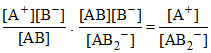 . [B-]2
⇒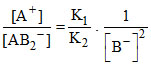
Therefore, (D) option is correct.
K1 =
K2 = K1/K2 =
. [B-]2⇒
Therefore, (D) option is correct.
Create a free account to view solution
View Solution FreeMore Chemical Equilibrium Questions
For the given reaction 2A(s) + B(g) $\rightleftharpoons$C(g) + 2D(s) + E(s), the extent of reaction of B was found to be...In the decomposition equilibrium of a certain alkaline earth metal carbonate, the partial pressure of CO2 becomes a hund...The value of KP for the reaction N2O4(g) $\rightleftharpoons$2NO2 is 640 mm at 775 K. The percentage dissociation of N2O...In the system AB(s) $\rightleftharpoons$A(g) + B(g), doubling the quantity of AB(s) would...For the reaction A + B$\rightleftharpoons$C + D, the initial concentration of A and B is equal, but the equilibrium conc...