SolutionHard
Question
An ideal mixture of liquids A and B with 2 moles of A and 2 moles of B has a total vapour pressure of 1 atm at a certain temperature. Another mixture with 1 mole of A and 3 moles of B has a vapour pressure greater than 1 atm. But if 4 moles of C are added to the second mixture, the vapour pressure comes down to 1 atm. Vapour pressure of C, Pc0 = 0.8 atm. Calculate the vapour pressures of pure A and pure B.
Options
A.PA0 = 1.4 atm, PB0 = 0.7 atm
B.PA0 = 1.2 atm, PB0 = 0.6 atm
C.PA0 = 1.4 atm, PB0 = 0.6 atm
D.PA0 = 0.6 atm, PB0 = 1.4 atm
Solution
 = 1 atm ⇒ PAo + PBo = 2 atm
 > 1 atm ⇒ PAo + 3PBo > 4 atm
&
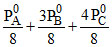 = 1 atm ⇒ PAo + 3PBo + 4 PCo = 8 atm
so PAo + 3PBo = (8 - 4 × 0.8) atm = 4.8 atm
Hence PBo = 1.4 atm
PAo = 0.6 atm
Create a free account to view solution
View Solution FreeMore Solution Questions
Which one of the following pairs of solution can we expect to be isotonic at the same temperature?...For the given electrolyte AxBy, the degree of dissociation ′a′ can be given as...At a constant temperature, DS will be maximum for which of the following processes :...A mixture of ethyl alcohol and propyl alcohol has a vapour pressure of 290 mm at 300 K. The vapour pressure of propyl al...Blood cells in the human body have semipermeable membrane and depending upon the concentration of solution inside blood ...