Coordination CompoundHard
Question
Which of the following statements is/are true for the complexes, [Fe(H2O)6]2+, [Fe(CN)6]4-, [Fe(C2O4)3]3- and [Fe(CO)5] ?
Options
A.Only [Fe(C2O4)3]3- show optical isomerism.
B.[Fe(C2O4)3]3- is less stable than [Fe(CN)6]2-
C.All complexes have same effective atomic number.
D.[Fe(CO)5] shows back bonding.
Solution
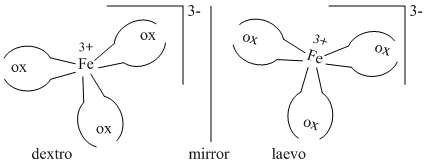
[Fe(H2O)6]2+ and [Fe(CN)6]4- do not show optical isomerism because of the presence of plane of symmetry as well as centre of symmetry.
(B) [Fe(C2O4)3]3 has three, five membered chelating rings and thus is more stable due to chelation.
(C) [Fe(H2O)6]2+ ; EAN = 26 - 2 + 12 = 36
[Fe(CN)6]4- ; EAN = 26 - 2 + 12 = 36
[Fe(C2O4)3]3- ; EAN = 26 - 3 + 12 = 35
(D) Fe
 CO
COCreate a free account to view solution
View Solution FreeMore Coordination Compound Questions
The hypothrtical complex chlorodiaqatriamminecobalt (III)chloride can be represented as...Co-ordination number of Cr in CrCl3.5H2O is six. The maximum volume of 0.1 N AgNO3 needed to precipitate the chlorine in...In which of the following pairs both the complexes show optical isomerism ?...The ion which is not tetrahedral in shape is...Which one of the following complexes is an outer orbital complex?...