Chemical Kinetics and Nuclear ChemistryHard
Question
for a reaction A → B, Ea = 10 kJ mol-1, ᐃH = 5 kJ mol-1. Thus, potential energy profile for this reaction is :
Options
A.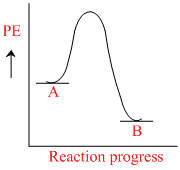
B.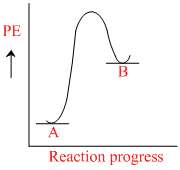
C.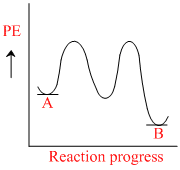
D.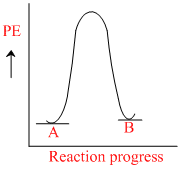
Solution
For reaction, A → B.
Ea = 10 kJ/mole , ᐃH = 5 kJ/mole
Rxn endothermic because ᐃH (+)
ᐃH = Ea - Eb
5 = 10 - Eb
Eab = 10 - 5 = 5 kJ/mole. Then [B].
Ea = 10 kJ/mole , ᐃH = 5 kJ/mole
Rxn endothermic because ᐃH (+)
ᐃH = Ea - Eb
5 = 10 - Eb
Eab = 10 - 5 = 5 kJ/mole. Then [B].
Create a free account to view solution
View Solution FreeTopic: Chemical Kinetics and Nuclear Chemistry·Practice all Chemical Kinetics and Nuclear Chemistry questions
More Chemical Kinetics and Nuclear Chemistry Questions
For a first-order reaction,...Consider an endothermic reaction, X → Y with the activation energies Eb and Ef for the backward and forward reacti...Consider the following reactions. $A\overset{\quad K_{1} = 6.93 \times 10^{- 2}\text{ mi}\text{n}^{- 1}\quad}{\rightarro...For the reaction system: 2NO(g) + O2(g) → 2NO2(g) volume is suddenly reduce to half its value by increasing the pr...The decomposition reaction 3A(g) → 2B(g) + 2C(s) follows first-order kinetics. Starting with pure ‘A’ (at 6 atm), the pr...