Chemical Kinetics and Nuclear ChemistryHard
Question
Consider following reaction,
Zn + 2H+ → Zn2+ + H2
Half-life period is independent of concentration of Zn at constant pH. At constant Zn concentration, half-life is 10 minutes at pH = 2 and half-life is 100 minutes at pH = 3. Hence, rate law is :
Zn + 2H+ → Zn2+ + H2
Half-life period is independent of concentration of Zn at constant pH. At constant Zn concentration, half-life is 10 minutes at pH = 2 and half-life is 100 minutes at pH = 3. Hence, rate law is :
Options
A. k [Zn][H+]
B.k [Zn][H+]2
C.k [Zn]0 [H+]
D.k [Zn]0 [H+]2
Solution
Half life period independent on conc.hence order is unity wrt Zn
Let order with respect to H+ ions is ′a′
Then the rate law will be Rate = k [Zn][H+]a
At pH = 2, [H+] = 10-2 So the rate law becomes Rate = (k[10-2]a)[Zn] = k1 [Zn]
so the half life will be T1/2 =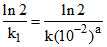 = 10 min
At pH = 3, [H+] = 10-3 So the rate law becomes Rate = (k[10-3]a )[Zn] = k2 [Zn]
so the half life will be T1/2 =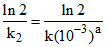 = 100 min
so we have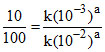
which will give 10-1 = 10-a
Hence a = 1
Let order with respect to H+ ions is ′a′
Then the rate law will be Rate = k [Zn][H+]a
At pH = 2, [H+] = 10-2 So the rate law becomes Rate = (k[10-2]a)[Zn] = k1 [Zn]
so the half life will be T1/2 =
= 10 minAt pH = 3, [H+] = 10-3 So the rate law becomes Rate = (k[10-3]a )[Zn] = k2 [Zn]
so the half life will be T1/2 =
= 100 minso we have
which will give 10-1 = 10-a
Hence a = 1
Create a free account to view solution
View Solution FreeTopic: Chemical Kinetics and Nuclear Chemistry·Practice all Chemical Kinetics and Nuclear Chemistry questions
More Chemical Kinetics and Nuclear Chemistry Questions
The specific constant of a first order reaction depends on the :...For the first order reaction 2N2O5 (g) → 4NO2(g) + O2(g)...The reaction of NO2 (g) and O3 (g) is first-order in NO2 (g) and O3 (g) 2NO2 (g) + O3 (g) → N2O5 (g) + O2 (g)The r...For the reaction A2(g) → B(g) + ½C(g), pressure of the system increases from 100 to 120 mm in 5 minutes. The average rat...With the help of following reactions, arrange metals A,B,D and E in decreasing order of their reactivity :-(i) B + ANO3 ...