Chemical Kinetics and Nuclear ChemistryHard
Question
Acid catalysed hydrolysis of ester is first-order reaction and rate constant is given by
k =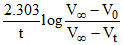
where V0, Vt and V∞ are the volume of standard NaOH required to neutralise acid present at a given time ; if ester is 50% hydrolysed then :
k =
where V0, Vt and V∞ are the volume of standard NaOH required to neutralise acid present at a given time ; if ester is 50% hydrolysed then :
Options
A.V∞ = vt
B.V = (Vt - V0)
C.V∞ = 2Vt - V0
D.V∞ = 2Vt + V0
Solution
If easter 50% hydrolysed then
x =
(a0 - x) =
We can write
a0 ∞ (V∞ - V0)
(a0 - x) ∞ (V∞ - Vt)
 = (V∞ - Vt)
V∞ - V0 = 2V∞ - 2Vt
Vt =
or V∞ = 2 Vt - V0
x =
(a0 - x) =
We can write
a0 ∞ (V∞ - V0)
(a0 - x) ∞ (V∞ - Vt)
= (V∞ - Vt)V∞ - V0 = 2V∞ - 2Vt
Vt =
or V∞ = 2 Vt - V0
Create a free account to view solution
View Solution FreeTopic: Chemical Kinetics and Nuclear Chemistry·Practice all Chemical Kinetics and Nuclear Chemistry questions
More Chemical Kinetics and Nuclear Chemistry Questions
A reaction which is of first order w.r.t reactant A, has a rate constant 6 min-1. If we start with [A] = 0.5 mol L-1, wh...The rate constant is given by the equation $K = P.A.e^{- E_{a}/RT}$. Which factor should register a decrease for the rea...The activation energies of two reactions are E1 and E2 with E1 > E2. If the temperature of the reacting system is inc...Consider following reaction, Zn + 2H+ → Zn2+ + H2Half-life period is independent of concentration of Zn at constan...The electrical change on a colloidal particle is observed by:...