Application of DerivativeMedium
Question
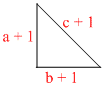
If (1 + 3 + 5 + ...+ a) + (1 + 3 + 5 + ...+ b) = (1 + 3 + 5 + ...+ c), where each set of paren theses contains the sum of consecutive odd integers as shown such that - (i) a + b + c = 21, (ii) a > 6 If G = Max{a, b, c} and L = Min{a, b, c}, then -
Options
A.G - L = 4
B.b - a = 2
C.G - L = 7
D.a - b = 2
Solution
 (2r - 1) = n2
⇒ a = 2n - 1
⇒ n =

⇒ (a + 1)2 + (b + 1)2 = (c + 1)2
= 8 = 6 = 10 (∵a + b + c = 21)
⇒ a = 7 b = 5 c = 9
Hence G = 9 L = 5
G - L = 4 & a - b = 2
Create a free account to view solution
View Solution FreeMore Application of Derivative Questions
The curve x2 - y2 = 5 and = 1 cut each other at any common point at an angle-...Point on the curve y2 = x - 2, the normal at which is also the normal to the curve x2 = y - 2...If curve y = 1 - ax2 and y = x2 intersect orthogonally then the value of a is...At what point the slope of the tangent to the curve x2 + y2 - 2x - 3 = 0 is zero -...The value of dy/dx at the point where normal to the curve y = f(x) make equal intercepts with positive direction of coor...