Chemical Kinetics and Nuclear ChemistryMedium
Question
The rate constant of a reaction is given by k = 2.1 × 10¹⁰ exp(-2700/RT). It means that
Options
A. log k versus 1/T will be a straight line with slope = 
B.log k versus 1/T will be a straight line with intercept on log k axis = 2.1 × 10¹⁰.
C.The number of effective collisions are 2.1 × 1010cm-3s-1.
D.Half life of the reaction increases with increase of temperature.
Solution
For Arrhenius equation k = Ae-Ea/RT
= 2.1 × 10¹⁰ × e-2700/RT
or
log k = log A - = log 2.1 × 10¹⁰ -
Plot of log k vs 1/T
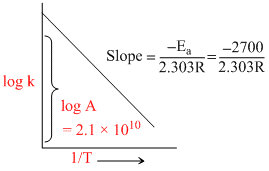
= 2.1 × 10¹⁰ × e-2700/RT
or
log k = log A -
= log 2.1 × 10¹⁰ - Plot of log k vs 1/T
Create a free account to view solution
View Solution FreeTopic: Chemical Kinetics and Nuclear Chemistry·Practice all Chemical Kinetics and Nuclear Chemistry questions
More Chemical Kinetics and Nuclear Chemistry Questions
The specific constant of a first order reaction depends on the :...At room temperature, the reaction between NO and O2 to give NO2 is fast, while that between CO and O2 is slow. It is due...A reaction is catalysed by H+ ion;and in the rate law the dependence of rate is of first order with respect to the conce...Correct order of radii is :-...The following data certain to reaction between A and B ; Which of the following inference(s) can be drawn from the above...