Trigonometric EquationHard
Question
Let  (the set of all real numbers) be a positive, non-constant and differentiable function such that f′(x) < 2f(x) and
  Then the value of
  lies in the interval
(the set of all real numbers) be a positive, non-constant and differentiable function such that f′(x) < 2f(x) and Then the value of lies in the intervalOptions
A.(2e - 1, 2e)
B.(e - 1, 2e - 1)
C.
D.
Solution
f′(x) - 2 f(x) < 0
Multiply both side by e-2x
e-2x f′(x) - 2e-2x f(x) < 0
 (e-2x f(x)) < 0
Now, g(x) = e-2x f(x)
∴ g(x) is a decreasing function.


⇒ e-2x f(x)<
⇒ f(x) < e2x-1
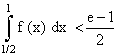
⇒
⇒
obviously f(x) is positive
∴
Multiply both side by e-2x
e-2x f′(x) - 2e-2x f(x) < 0
(e-2x f(x)) < 0 Now, g(x) = e-2x f(x)
∴ g(x) is a decreasing function.
⇒ e-2x f(x)<
⇒ f(x) < e2x-1
⇒
⇒
obviously f(x) is positive
∴
Create a free account to view solution
View Solution FreeMore Trigonometric Equation Questions
A particle acted on by constant forces and is displaced from the point to the point . The total work done by the forces ...The general solution of the equation 7 cos2 x + sin x cos x − 3 = 0 is given by-...Number of ordered pairs (a, x) satisfying the equation sec2( a + 2) x + a2 - 1 = 0; - π < x < π is -...If cos2A + cos2B + cos2C = 1, then ᐃABC is -...If 0 2θ - 5 sin θ + 2 > 0, is...