Errors in measurementMedium
Question
Students I1, J1,J3 and I2 perform an experiment for measuring the acceleration due to gravity (g) using a simple pendulum. They use different lengths of the pendulum and record time for different number ofoscillations. The observations are shown in the table.
Least count for length = 0.1 cm, Least count for time = 1s
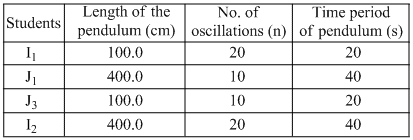
If P1,P2,P3 and P4 are the % error in g for students I1,J1,J3 and I2 respectively then -
Least count for length = 0.1 cm, Least count for time = 1s
If P1,P2,P3 and P4 are the % error in g for students I1,J1,J3 and I2 respectively then -
Options
A.P1 = P3
B.P3 is maximum
C.P4 is minimum
D.P2 = P4
Solution
T = 2π ⇒ g ∝ lT-2 =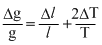
Therefore P = 100 ⇒ P1 =
  × 100 = 0.6%, P2 =
  × 100 = 0.42%
P3 = × 100 = 1.1%, P4 =
  × 100 = 0.28%
⇒ g ∝ lT-2 = Therefore P =
100 ⇒ P1 = × 100 = 0.6%, P2 = × 100 = 0.42%P3 =
× 100 = 1.1%, P4 = × 100 = 0.28%Create a free account to view solution
View Solution FreeMore Errors in measurement Questions
The respective number of significant figures for the numbers 23.023, 0.0003 and 2.1 × 10⁻³ are...If error in messing diameter of a circle is 4 %, the error in the radius of the circle would be...If in an experiment for determination of velocity of sound by resonance tube method using a tuning fork of 512 Hz, first...The period of oscillation of a simple pendulum is T = . Measured value of L is 20.0 cm known to 1 mm accuracy and time f...In a vernier, N divisions of vernier scale coincide with (N - 1) divisions of main scale (in which 1 division) represent...