Chemical Kinetics and Nuclear ChemistryMedium
Question
the density of gold is 19g/cm3. If 1.9 × 10⁻⁴g of gold is dispersed in one litre of water to give a sol having spherical gold particles of radius 10 nm, then the number of gold par tiles per mm3 of the so will be
Options
A.1.9 × 1012
B.6.3 × 1014
C.6.3 × 1010
D.2.4 × 106
Solution
Volume of gold present in solution
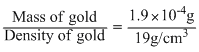
= 0.1 × 10⁻⁴ cm3
For spherical particle of gold with radius equal to 10mn The volume of each particle
= πr3 =
πr3 =  ×(10 × 10-7cm)3
= ×
×
Number of gold particle present
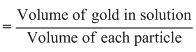
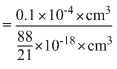
 × 1013 particles
= 2.4 × 10¹² particles
= 2.4 × 10¹² particles of gold are present in 1000cm3 (1litre).
∴ Number of particles present per mm3
 [1L = 106 mm3]
= 2.4 × 106
= 0.1 × 10⁻⁴ cm3
For spherical particle of gold with radius equal to 10mn The volume of each particle
=
πr3 = ×(10 × 10-7cm)3=
× Number of gold particle present
× 1013 particles = 2.4 × 10¹² particles
= 2.4 × 10¹² particles of gold are present in 1000cm3 (1litre).
∴ Number of particles present per mm3
[1L = 106 mm3]= 2.4 × 10⁶
Create a free account to view solution
View Solution FreeTopic: Chemical Kinetics and Nuclear Chemistry·Practice all Chemical Kinetics and Nuclear Chemistry questions
More Chemical Kinetics and Nuclear Chemistry Questions
Which one of the following statements for order of a reaction is not correct?...Decrease in atomic number is observed during :...For a first-order reaction, t0.75 = 1386 s. Its specific reaction rate is...t1/4 can be taken as the time taken for the concentration of a reactant to drop to of its initial value. If the rate con...Rate of a reaction can be expressed by Arrhenius equation as: k = A e-E /RT In this equation, E represents...