JEE Advanced | 2014FunctionMedium
Question
Let f : (0, ∞) → R be given by f(x) =  . Then
. ThenOptions
A.f(x) is monotonically increasing on [1, ∞)
B.f(x) is monotonically decreasing on (0, 1)
C.f(x) + f = 0, for all x ∈ (0, ∞)
= 0, for all x ∈ (0, ∞)D.f(2x) is an odd function of x on R
Solution
f(x) = 
f′(x) = > 0
> 0
Also, f(x) + f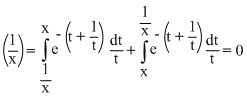
and so, f(2x) + f(2-x) = 0
i.e., (A, C, D) is correct answer.
f′(x) =
> 0Also, f(x) + f
and so, f(2x) + f(2-x) = 0
i.e., (A, C, D) is correct answer.
Create a free account to view solution
View Solution FreeMore Function Questions
If f(x) is negative & 2f(sinx) + √2 f(-cosx) = - tanx,then value of f (1/2) is...f(x) = cos √x, correct statement is -...The period of function |cos 2x| is -...If f(x) = cos x + sin x, [x] denoting the greatest integer function, then -...Let the domain of the function$$f(x) = \log_{3}\log_{5}\left( 7 - \log_{2}\left( x^{2} - 10x + 85 \right) \right) + \sin...